



















Best viewed using:
Internet Explorer
or
Mozilla Firefox


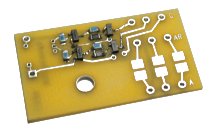
The Boosters come in 3 flavors: N8103-1 to support a single output Simulator (i.e., N8032 Beacon), N8103-2 for 2 output Simulators (i.e., N8038 Early-era Alternating Flasher), and N8103-3 for 3-output Simulators (i.e., N8043 Universal Strobe). A Simulator is easily be piggybacked on a Booster Board (connecting wire included) and share a common power input for both.
Supports up to 200mA and 18VDC per output channel


To achieve the the
greatest degree of realism, many modeling projects desire lighting effects
that go well beyond simple static lighting. Many require effects that are quite dynamic, producing animated behavior to mimic
a wide variety of devices.
Below are our products
specifically designed for LEDs that we've developed
to support a wide range of dynamic lighting effects. We hope you find them
innovative.
Due to the
wide variety of modeling scales, LEDs for use with
these products are sold
separately and can be found by clicking on the
Lighting Products link at the left side of this page.
  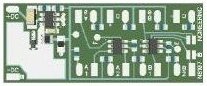 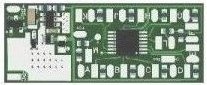  |
This simulator provides a single repeating burst, increasing and decreasing in intensity to accurately represent beacons like those made by Prime and Federal. The N8032 will support yellow or red 20ma LEDs, when used with red, it is an excellent choice for , radio, cell or water tower, or other structure height warning beacon for aircraft. N8032A is configured for white or blue LEDs, and the N8032B has 2 selectable speeds.
Item#
Cart
Price
N8032
$12.95
NLA8032
$13.95
NLD8032
$13.95
N8032A
$12.95
N8032B
$13.95
NLA8032A
$13.95
NLA8032B
$14.25
NLD8032A
$13.95
NLD8032B
$14.25
| More Info |
| Which Sim is best for me? |
| Connecting N8032/A |
| Connecting N8032B |
| Connecting NLA8032/A |
| Connecting NLA/D8032B |
| Video of effect |
| More Info |
| Connecting N8035 |
| Connecting N8035A |
| Video of effect |
This simulator is designed to generate slowly increasing and decreasing brightness of two alternating LEDs. The effect is timed to accurately represent the slowly rotating beacon in a lighthouse with a higher intensity white light followed by a lower intensity green light (rear of beacon). The N8035A version is for a single white LED (flashing twice as often to achieve the same rotational timing effect).
| Item# | Cart | Price |
| N8035 | $12.95 | |
| N8035A | $12.95 | |
| N8035B | $13.95 |
Rotating Beacon Simulator
This module is designed to reproduce a highly realistic simulation of a rotating beacon by sequencing 3 yellow or red LEDs (sold separately) that are positioned to produce the effect. See LED Construction in the More Info table to the right for complete information. The timing of the rotational effect closely replicates that of typical rotating beacons. Occasionally seen near building fronts or signs as "attention getters". As red beacons, they are used as warning for bridge lifts and other moving structures.
| More Info |
| Which Sim is best for me? |
| Connecting N8042 |
| Connecting NLA8042 |
| LED Construction |
| Video of effect |
| Item# | Cart | Price |
| N8042 |
$12.95 |
|
| NLA8042 | $13.95 |
Furnace / Forge / Sawdust Burner Simulator
This module generates a slow, random undulating brightness output for either a single LED, or 2 series-wired LEDs. The effect replicates the glow seen in furnaces, forges and wigwam (sawdust) burners. Ideal for these applications and other factory or shop buildings where these type of heat sources are present. The use of 2 LEDs give double the light output and when strategically placed, can create a excellent "shine" effect off other nearby surfaces.
| More Info |
| Which Sim is best for me? |
| Connecting N8046 |
| Connecting NLA8046 |
| Adding "hot coals" |
| Video coming soon |
| More Info |
| Which Sim is best for me? |
| Connecting N8037 |
| Connecting NLA8037 |
| Video coming soon |
This simulator replicates the older-style signal and hazard warning flashers that used incandescent (filament) lamps to generate light. Typical flash rate of 3/4 second with a increasing and decreasing brightness curve to duplicate that of filament type lamps. Three outputs will each drive up to one pair (wired in series) of red and/or yellow LEDs Outputs flash sequentially so the module could also drive a very short series of "chase" lights.
| Item# | Cart | Price |
| N8037 | $13.25 | |
| NLA8037 | $14.95 |
| Item# | Cart | Price |
| N8046 |
$13.95 |
|
| NLA8046 | $14.95 | |
| NLD8046 | $14.95 |
Campfire / Fireplace Simulator
This simulator produces a random varying change in output intensity for either a single LED, or 2 series-wired LEDs. The effect realistically mimics the crackling fire in a fireplace or of a campfire. Perfect to add the reflective effect inside a building or house for the added warmth and that "lived-in" look. If used with our Nano LEDs even the smallest scale scene can enjoy the realism this effect produces, such as an outdoor BBQ or a backyard burn pile.
| Item# | Cart | Price |
| N8103-1 | $12.95 |
|
| N8103-2 |
$14.95 |
|
| N8103-3 |
$16.95 |
| More Info |
| Connecting |
AUTOMATIC CURRENT PROTECTION!
At just 3/4" square, this product series includes a state-of-the-art current source which provides a constant 20 ma for LEDs connected to the module. This means any color 20 ma LED can be connected without the need for external current limiting resistors, multiple LEDs can be connected in series (requires a power source of sufficient voltage) and different colors of LEDs can be combined in the same series. All will operate at 20 ma.
For certain applications it may be desirable to have the LED (or series string) connected to operate at less than full brightness. For this purpose, solder pads are included on the back of the module for placement of resistors to adjust of current source output.
Input voltage range 6-16 VDC. Extra power wires included.
| More Info |
| Which Sim is best for me? |
| Connecting N8047 |
| Connecting NLA8047 |
| Adding "hot coals" |
| NK8047/-2 info |
| Video of effect |
| Item# | Cart | Price |
| N8069 |
$14.95 |
| Item# | Cart | Price |
| N8067 |
$13.95 |
| Item# | Cart | Price |
| N8047 |
$13.95 |
|
| NLA8047 | $14.95 | |
| NK8047 |
$30.95 |
|
| NK8047-2 |
$30.95 |
Structure Lighting Simulator & Controller Module
Here is a way to create a bit of animation for that factory, office building, or house structure that gives the appearance of activity going on inside. The N8048 module turns on and off 3 different outputs at varying intervals for varying time periods of a 10-minute cycle, then turns all outputs off for 15 minutes, then starts over. A timing table is included with each module that shows the sequencing of the 3 outputs. See More info for connecting and timing tables.
The N8071B is configured for the primary (top of tower) white LED. This is typical for towers with a strobe light at top position.
The N8048C Controller module triggers 3 separate outputs at timed intervals and is designed specifically to be used as an automatic sequence controller for multiple N8048 Structure Lighting Simulators. Units can be cascaded for any size application.
| More Info |
| Connecting |
| Video of effect |
| Item# | Cart | Price |
| N8012 | $12.95 |
Alternating Flasher
This module creates an alternating flash between a pair (or pairs) of LEDs of approximately 3/4 of a second and 50% duty cycle. This is a typical sequence for standard modern-day warning flashers for low bridges, etc. This product supports "common anode" devices, see More Info for details.
| More Info |
| Connecting |
| Video coming soon |
| More Info |
| Connecting |
| Video coming soon |
| More Info |
| Connecting |
| Video coming soon |
| More Info |
| Connecting |
| Video coming soon |
| More Info |
| Which Sim is best for me? |
| Connecting N8049/A |
| Connecting NLA8049/A |
| Video coming soon |
| Item# | Cart | Price |
| N8049C |
$14.95 |
|
| 2 or more | $11.95 each | |
| N8049D |
$14.95 |
|
| 2 or more | $11.95 each |
| Item# | Cart | Price |
| N8049 |
$14.95 |
|
| NLA8049 |
$15.95 |
|
| N8049A |
$14.95 |
|
| NLA8049A | $15.95 |
Defective Sign/Light Simulators
The N8069 is a 3-output simulator that reproduces the effect of a flickering or defective light on its first output channel, with the remaining 2 channels being on continuously. This allows connected LEDs to be strategically placed in model signs to display this effect dramatically. It can also be used in building, streetlights, or railroad passenger cars for the same effect. How about creative placement in a back-lit building sign for a humorous effect.
Arc & Gas Welder Simulators
Finally, welding simulation that looks just like the real thing! A bit of shameless back-patting, but we believe it is warranted. These simulators are configured for connection of two LEDs to accurately reproduce the varying intensity, intermittence and slight color changes just like real welders. Our Nano LEDs are perfect for reproducing these effects. N8064 is the arc welder and N8064B is the gas welder. See Connecting under More Info to the right, for product details.The N8046B-2 is programmed with a start feature to run with the N8X0X-092 Gas Welder sound effect.
Cascadable Chase Light Simulator
This simulator will sequence 6 white or yellow-white LEDs in succession (1 through 6) then repeat over and over when input control is grounded (-DC). Unlike the chase light Simulator above, this version can be cascaded together for a virtually unlimited chase sequence. Click on Connecting in More Info (to the right) for details of wiring and operation. The N8049D version is for red, orange, and/or yellow LEDs.
6-LED Chase Light Simulator
This simulator will sequence 6 white or yellow-white LEDs in two different ways. With the input control pin left unconnected, LEDs will light in succession (1 through 6) then repeat over and over. With input control grounded (-DC), LEDs will sequence in an up and down fashion (1,2,3,4,5,6,5,4,3,2,1) and repeat over and over. The N8049A version is for red, orange, and/or yellow LEDs. Perfect for lighting attention-getting signage on building and store fronts, eateries, bars, etc.
| More Info |
| Connecting Arc |
| Connecting Gas |
| Video of effect |
| Item# | Cart | Price |
| N8071 |
$14.95 |
|
| N8071B | $14.95 |
| Item# | Cart | Price |
| N8064 |
$13.95 |
|
| N8064B | $13.95 | |
| N8064B-2 | $13.95 |
| More Info |
| Connecting |
| Video of effect |
| More Info |
| Connecting |
| Timing tables |
| Item# | Cart | Price |
| N8014 | $15.25 |
Variable-rate Alternating Flasher
This module creates an alternating flash between a pair (or pairs) of LEDs with a 50% duty cycle (equal on and off times). Rate of flash is adjustable from 30 flashes per second (33 ms) to one flash every 3 seconds. This adjustment is made by rotating the slotted center of a variable resistor (bottom right corner of flasher). This product supports "common anode" devices, see More Info for details.| Item# | Cart | Price |
| N8048 |
$14.95 |
|
| N8048C | $12.95 |
TV Flicker Simulator
This module simulates the reflective light given off by a television set within a structure’s area such as a living room, office or family area, or a viewing area in a passenger coach. The pseudo-random change in intensity and variation in timing produces a very realistic effect.
Tower Beacon/Strobe Simulator
The N8071 is configured to generate either a beacon effect (ramping up & down of brightness - the default setting), or a strobe effect for the primary (top of tower) red LED. Additionally, up to 4 more red or yellow LEDs can be connected which will run in a continuously-on state. This configuration allows this module to simulate the lighting of many different radio, cell and TV towers.
| More Info |
| Connecting |
| Video of effect |
Signal Flasher
Produces a flash of 3/4 of a second (700-750 ms) with a 50% duty cycle (equal on and off periods). This simulates the style of flasher used for various modern-era air traffic clearance indicators for buildings, radio towers, bridges, etc.
| Item# | Cart | Price |
| N8013 | $13.65 |
Variable-rate Flasher
Produces a flash with a 50% duty cycle (equal on and off times). Rate of flash is adjustable from 30 flashes per second (33 ms) to one flash every 3 seconds. This adjustment is made by rotating the slotted center of a variable resistor (bottom right corner of flasher). This flexibility allows for adaptation to a wide variety of structure warning and attention lighting.
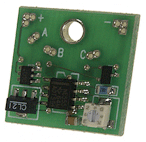
Custom Lighting Effect Simulators
Do you need a special lighting effect that that
no one produces or have a unique prototype requirement? We may be able to
help. The N8050 will support 1 LED output, the N8051, 2 LED outputs, and the
N8052 will support 3 LED outputs. For an additional programming charge
(quoted separately), we will program the appropriate simulator to create
your effect. Just email or call us with your requirements. We will review
them, determine if they are within the capabilities of our simulator, and if
so, respond with our quotation. Delivery can be within 2 weeks and our quote
will be reasonable. $12.95 $13.95 $14.95
Item#
Cart
Price
N8050
NLA8050
$13.95
NLD8050
$13.95
N8051
NLA8051
$14.95
NLD8051
$14.95
N8052
NLA8052
$15.95
NLD8052
$15.95
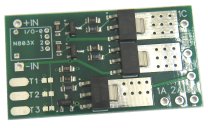
$14.95 $16.95 $18.95 Very high current output boost plus
added control solder points
Item#
Cart
Price
N8103A-1
N8103A-2
N8103A-3
As with the N8103 Booster Boards above, these Super Boosters come in 3
flavors: N8103A-1 to support a single output Simulator, N8103A-2 for 2 output Simulators, and N8103A-3 for 3-output Simulators.
A Simulator is easily be piggybacked on a Booster Board (connecting wire
included) and share a common power input for both.
Our Simulator
boards can also be programmed to perform as timer modules to turn on and
off outputs in timing ranges from seconds (or even milli-seconds) to
hours. When coupled with these Super Boosters a vary wide range of
control and automation can be performed.
Standard voltage
operating range for the Super Booster Board is 6 to 18 volts DC. This
voltage range is determined by the on-board voltage regulator mounted on
our Simulator boards.
| More Info |
| Connecting |
| Video of effect |
| Item# | Cart | Price |
| N8015 | $15.95 |
| More Info |
| Connecting |